
PMI

The ServiceNow Certified Implementation Specialist – Data Foundations (CIS-DF) certification is a specialized credential designed for professionals who implement and maintain foundational data structures within the ServiceNow platform. This certification validates an individual's expertise in configuring and managing the Configuration Management Database (CMDB) and understanding the Common Service Data Model (CSDM), critical for successful IT operations and digital transformation initiatives. Ideal candidates for the CIS-DF exam are IT professionals, system administrators, and consultants involved in CMDB and CSDM implementation. This comprehensive guide explores the exam's structure, syllabus, benefits, and effective preparation strategies to help you determine if pursuing the ServiceNow CIS-DF certification aligns with your career objectives.
The ServiceNow Certified Implementation Specialist – Data Foundations certification, identified by the exam code CIS-DF, focuses on the fundamental aspects of data management within the ServiceNow ecosystem. Achieving this certification demonstrates a professional’s ability to configure and manage the core data components that underpin most ServiceNow applications, primarily the Configuration Management Database (CMDB) and the Common Service Data Model (CSDM). This includes understanding how to establish a robust and accurate data foundation, crucial for advanced IT Service Management (ITSM), IT Operations Management (ITOM), and other strategic business applications. Earning the CIS-DF can significantly enhance an individual's credibility and effectiveness in roles requiring deep insight into ServiceNow's data architecture.
The official exam specifications provide a clear outline for candidates:
• Exam Name: ServiceNow Certified Implementation Specialist – Data Foundations
• Exam Code: CIS-DF
• Exam Price: USD $450
• Duration: 90 Minutes
• Number of Questions: 75
• Passing Score: Pass / Fail
These details highlight the time commitment and scope of knowledge required to successfully navigate the certification process. For detailed exam information, visit the CIS-DF exam page.
Understanding the ServiceNow CIS-DF exam syllabus is crucial for effective preparation. The exam is structured around key functional areas, each with a specific weightage, reflecting their importance in managing ServiceNow data foundations. These domains ensure that certified professionals possess a holistic understanding of data configuration, ingestion, governance, and analysis, all within the context of the Common Service Data Model. This structured approach helps candidates focus their study efforts on the most critical topics.
The syllabus topics and their respective weightages are as follows:
• Configuration (15%): This domain covers the foundational setup of the CMDB, including class management, relationship definitions, and discovery patterns. Candidates need to understand how to establish a robust CMDB structure that accurately reflects the organization's IT environment.
• Ingest (19%): Focuses on various methods for bringing data into the CMDB. This includes topics like data import sets, transform maps, discovery, and integration with external sources. Efficient data ingestion is vital for maintaining a current and accurate CMDB.
• Govern (35%): The largest domain, emphasizing data quality, hygiene, and management. This includes reconciliation rules, identification rules, data certification, and general CMDB health. Strong governance ensures the reliability and trustworthiness of CMDB data.
• Insight (20%): Covers how to extract value and intelligence from the CMDB. This involves reporting, dashboards, and analytics related to configuration items (CIs) and their relationships, enabling data-driven decision-making.
• CSDM Fundamentals (11%): This section assesses knowledge of the Common Service Data Model, its principles, and how it guides the structuring of CMDB data to align with services. Understanding CSDM is essential for creating a service-aware CMDB. The official ServiceNow credential page provides comprehensive details on the exam and its objectives.
The ServiceNow CIS-DF certification is particularly valuable for a specific group of IT professionals aiming to solidify their expertise in data management within the ServiceNow platform. Individuals who regularly work with the Configuration Management Database (CMDB) and are involved in the implementation or maintenance of the Common Service Data Model (CSDM) will find this credential directly applicable to their daily tasks. The certification signals a high level of proficiency in establishing and maintaining the foundational data that drives various ServiceNow applications, making it an attractive qualification for consultants, implementers, and architects.
Professionals who stand to gain the most include:
• ServiceNow Implementation Specialists: Those responsible for deploying and configuring ServiceNow solutions, especially modules relying heavily on accurate CI data.
• CMDB Administrators: Individuals whose primary role involves managing, maintaining, and ensuring the health of the CMDB.
• ServiceNow Architects: Architects designing solutions that require a strong understanding of data structures and relationships to optimize performance and reporting.
• IT Operations Managers: Managers who oversee IT infrastructure and services and require reliable data for effective decision-making and incident resolution.
• Data Quality Analysts: Professionals focused on ensuring the accuracy, consistency, and integrity of data within the ServiceNow platform.
This certification is a tangible way to validate advanced skills and commitment to best practices in a critical area of the ServiceNow ecosystem.
While specific strict prerequisites for the ServiceNow CIS-DF exam are often outlined on the official ServiceNow training portal, candidates generally benefit immensely from a foundational understanding of the ServiceNow platform. Typically, aspiring CIS-DF holders should possess a strong background in IT Service Management (ITSM) and practical experience with CMDB concepts. It's not just about theoretical knowledge; hands-on experience in configuring and managing CMDB components within a ServiceNow instance is highly recommended. This practical exposure helps connect theoretical knowledge with real-world application, which is crucial for tackling scenario-based exam questions.
Key areas of recommended experience include:
• ServiceNow Platform Knowledge: A general understanding of how the ServiceNow platform operates, including its core applications and navigation.
• ITSM Fundamentals: Familiarity with IT Service Management processes such as Incident, Problem, Change, and Request Management, as these often interact with CMDB data.
• Basic CMDB Concepts: An understanding of Configuration Items (CIs), CI relationships, and the purpose of a CMDB in an enterprise environment.
• Data Import Experience: Prior work with data import sets, transform maps, and data integration techniques can be particularly beneficial, aligning with the 'Ingest' domain of the syllabus.
• CSDM Awareness: Even a rudimentary understanding of the Common Service Data Model and its value proposition can provide a strong starting point.
Candidates should aim for at least six months to one year of experience working with the ServiceNow platform, specifically in areas related to configuration management and data structuring, to feel confident in their preparation.
The CIS-DF certification demands a deep dive into several critical skill areas essential for managing robust data foundations within ServiceNow. These areas directly correspond to the exam's syllabus, requiring candidates to not only understand concepts but also demonstrate their practical application. Focusing on these specific domains can help structure study efforts and ensure comprehensive preparation.
Configuration forms the bedrock of an effective CMDB. This involves a thorough understanding of how to define and manage Configuration Item (CI) classes, create and maintain CI relationships, and implement Discovery patterns. Effective CMDB configuration goes beyond mere technical setup; it encompasses strategic decisions on what data to collect, how to model it, and ensuring that the CMDB accurately represents the operational environment. Best practices include designing a logical class hierarchy and defining clear, meaningful relationships between CIs to support various IT processes.
Data ingestion is about populating the CMDB with accurate and timely information. This domain covers a range of techniques, from manual data entry to automated discovery and integration with external systems. Candidates must be proficient in using ServiceNow’s powerful import sets and transform maps to bring data from disparate sources into the CMDB. Understanding the nuances of reconciliation and identification rules during ingestion is crucial to prevent data duplication and maintain data integrity. Furthermore, familiarity with Discovery and Service Mapping capabilities for automated CI population is highly beneficial.
The "Govern" domain is the most heavily weighted section of the exam, underscoring the paramount importance of data quality in the CMDB. This area explores strategies and tools for maintaining high-quality, reliable data. Key topics include understanding identification and reconciliation rules, which dictate how CIs are uniquely identified and updated. Data certification processes help validate the accuracy of CI data through user attestation. Implementing CMDB health dashboards and metrics, along with understanding de-duplication strategies, are essential for proactive data management. Effective data governance ensures that the CMDB remains a trusted source of truth for all IT processes.
Beyond populating and governing the CMDB, the ability to extract meaningful insights from the data is a vital skill. This domain focuses on using ServiceNow’s reporting and analytics capabilities to monitor CMDB health, track key performance indicators (KPIs), and identify trends in configuration data. Candidates should understand how to create various reports, dashboards, and performance analytics indicators that provide valuable intelligence for IT operations, capacity planning, and strategic decision-making. The goal is to transform raw configuration data into actionable information that supports business objectives.
The Common Service Data Model (CSDM) provides a standardized framework for organizing data within the CMDB to support IT services effectively. This domain requires understanding the different layers of the CSDM, such as foundational data, design, and service layers, and how they relate to each other. Grasping CSDM principles is crucial for building a service-aware CMDB, enabling better service reporting, impact analysis, and operational efficiency. It emphasizes a structured approach to mapping IT components to business services, ensuring consistency and clarity across the platform.
A strategic approach to preparing for the ServiceNow CIS-DF exam is essential for success. Simply reviewing concepts isn't enough; candidates need a structured study plan that includes official resources, practical application, and self-assessment. Effective preparation involves a combination of theoretical learning and hands-on experience to ensure a deep understanding of the platform's data foundations. Insights into passing, like those shared in the ServiceNow community blog, can be invaluable.
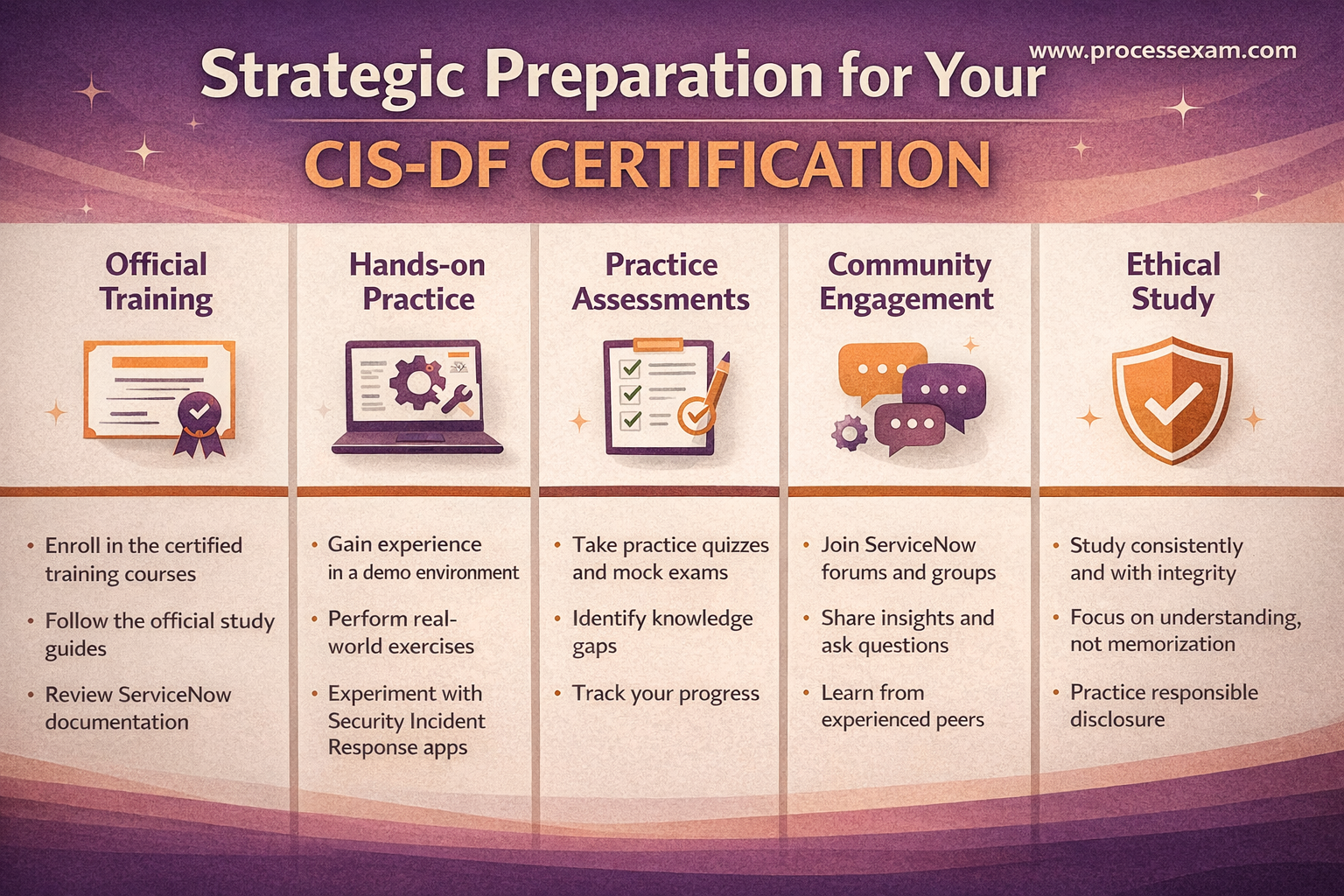 Consider these steps for a robust preparation plan:
1. Review Official Documentation: Start with the ServiceNow product documentation, specifically for CMDB, CSDM, Discovery, and ITOM applications. These resources provide the most accurate and up-to-date information.
2. Complete Official Training: Enroll in the recommended ServiceNow training courses related to Data Foundations. These courses are designed to cover the exam objectives comprehensively and often include labs for hands-on practice.
3. Gain Hands-on Experience: Regularly practice in a personal ServiceNow developer instance. This is critical for solidifying your understanding of configuration, import sets, transform maps, and CMDB health dashboards.
4. Utilize Practice Tests: Take practice questions to familiarize yourself with the exam format and identify areas needing further study. Ethical practice questions can help gauge readiness and build confidence without relying on unauthorized "dumps." For additional support, refer to proven tips for passing to refine your approach.
5. Engage with the ServiceNow Community: Participate in forums and community discussions. Learning from others' experiences and asking questions can provide valuable perspectives and clarify complex topics.
6. Create a Study Schedule: Allocate dedicated time each week for studying. Break down the syllabus into manageable sections and focus on the heavily weighted domains first.
Maintaining ethical study habits is paramount. Relying on "exam dumps" not only violates certification policies but also undermines the value of your credential, as it doesn't foster genuine understanding of the material.
Earning the ServiceNow CIS-DF certification offers a clear pathway for career advancement, positioning professionals as experts in a highly sought-after domain. In today's data-driven world, organizations increasingly rely on accurate and well-managed configuration data to make informed decisions, optimize IT operations, and achieve business objectives. A certified individual demonstrates not only a deep understanding of ServiceNow's data foundations but also a commitment to maintaining data integrity and leveraging CSDM best practices. The Credly digital badge signifies your achievement.
The benefits of holding this certification extend to:
• Enhanced Job Prospects: The demand for skilled ServiceNow professionals, particularly those with CMDB and CSDM expertise, continues to grow.
• Higher Earning Potential: Specialized certifications often correlate with increased salary and better opportunities for career growth.
• Credibility and Recognition: The CIS-DF credential validates your skills, making you a trusted expert in data foundation implementation.
• Impactful Contributions: With a solid understanding of data foundations, you can lead initiatives to improve IT service delivery, asset management, and operational efficiency within your organization.
• Foundation for Further Specialization: The CIS-DF serves as an excellent stepping stone for pursuing other advanced ServiceNow certifications in areas like IT Operations Management (ITOM) or IT Service Management (ITSM) that build upon a strong CMDB and CSDM.
This certification is more than just a badge; it's an investment in your professional future, equipping you with critical skills to navigate the complexities of enterprise IT environments.
The ServiceNow CIS-DF certification is a valuable asset for any IT professional serious about mastering the foundational data structures within the ServiceNow platform. By focusing on CMDB configuration, data ingestion, governance, and the Common Service Data Model, this credential validates a critical skillset necessary for optimizing IT operations and driving digital transformation. Whether you're an implementation specialist, a CMDB administrator, or an architect, the CIS-DF empowers you to build robust, accurate, and insightful data foundations.
If your career path involves managing complex IT environments and you aspire to be a key player in leveraging ServiceNow to its fullest potential, then the CIS-DF certification is undoubtedly worth considering. It provides a structured learning path and a recognized credential that can significantly enhance your professional standing and open doors to new opportunities. Take the next step in solidifying your ServiceNow expertise and explore further certification pathways to advance your career.
1. What roles are best suited for the ServiceNow CIS-DF certification?
The CIS-DF certification is ideal for ServiceNow Implementation Specialists, CMDB Administrators, ServiceNow Architects, and IT Operations Managers. It particularly benefits professionals involved in configuring, managing, and maintaining the CMDB and CSDM within a ServiceNow environment.
2. What is the approximate cost of the ServiceNow CIS-DF exam?
The current exam price for the ServiceNow CIS-DF certification is USD $450. This cost may vary by region and is subject to change, so it's always recommended to check the official ServiceNow certification page for the most up-to-date pricing information.
3. How much practical experience is recommended before attempting the CIS-DF exam?
While there isn't a strict mandatory experience prerequisite, ServiceNow typically recommends at least six months to one year of hands-on experience with the ServiceNow platform, specifically in areas related to CMDB and IT Service Management processes, to ensure adequate preparation.
4. Does the CIS-DF certification cover the Common Service Data Model (CSDM)?
Yes, the CIS-DF exam dedicates a specific section to CSDM Fundamentals, which accounts for 11% of the total syllabus. This ensures certified professionals understand how to structure CMDB data according to ServiceNow's recommended service data model.
5. What kind of career opportunities can the CIS-DF certification open up?
Earning the CIS-DF certification can lead to enhanced job prospects in roles such as ServiceNow Consultant, CMDB Specialist, IT Asset Manager, or even elevate existing roles by validating expertise in critical data foundations. It also serves as a strong foundation for pursuing further advanced ServiceNow specializations.