

Business Process Modeling Concepts alone accounts for 24% of the OMG OCEB2-FUND100 exam, more than any other domain by a wide margin. That single fact should shape how you study for the OMG Certified Expert in BPM 2 (OCEB 2) Fundamental Level certification, yet many candidates still split their time evenly across seven topics instead of following the weights.
This guide walks through every domain with its exact weight, explains what each one actually tests, and turns that into a study plan you can follow in weeks rather than guessing. By the end you will know where the 90 questions come from and how to spend your limited prep time where it counts most.
What the OCEB 2 Fundamental Certification Is and Who It Is For
OCEB2-FUND100 is the entry-level credential in the Object Management Group's BPM 2 certification program. It checks whether you understand the vocabulary and models that business process professionals use every day, before you move on to the intermediate and advanced OCEB 2 levels.
The certification suits business analysts, process owners, project managers and anyone who needs to read or write process documentation using the BPMN 2.0.2 notation. It does not assume deep technical skill. Instead it tests whether you can read a process diagram, name its parts correctly and connect that diagram to the business goals it supports.
There are no formal prerequisites for this exam. OMG states this plainly on its certification page, which makes OCEB2-FUND100 a reasonable starting point even if you have never sat a BPM exam before. That said, some exposure to BPMN diagrams or a short training course makes the material far easier to absorb.
Exam Format: Questions, Time, Fee and Passing Score
The numbers behind the exam are straightforward, and knowing them before you start removes a lot of exam-day uncertainty.
- Questions: 90, multiple choice, including some questions built around diagrams and images
- Time allowed: 90 minutes for residents of English-speaking countries, 120 minutes for everyone else
- Passing score: 62 out of 90 correct answers, or 69%
- Fee: 350 USD plus applicable taxes
- Languages: English and Japanese, with translation apps prohibited during the exam
- Validity: certifications expire three years after the exam date, extended by retaking the same or a higher level exam
- Delivery: scheduled through Pearson VUE, at a test center or online after a system check
A failed attempt comes with a 20% discount code toward a retake, and a passed exam unlocks a Credly digital badge within hours. These details come from the official BPM 2 Fundamental exam page, which is worth bookmarking because OMG updates fees and policies from time to time.
Ninety minutes for ninety questions sounds generous, roughly a minute per question, but diagram-based items can eat more than their share of that time. Pacing becomes more important once you reach the two largest domains, which we cover next.
The Seven Domains and Their Weights
OMG splits the OCEB2-FUND100 content into seven domains. Each one maps to a specific slice of the 90 questions, and the weights are published rather than estimated.
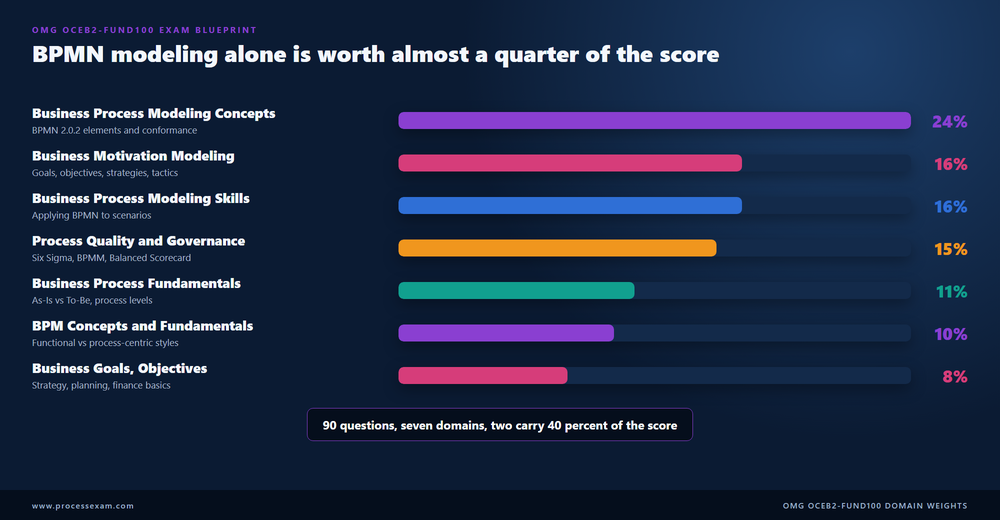
- Business Process Modeling Concepts: 24%
- Business Motivation Modeling: 16%
- Business Process Modeling Skills: 16%
- Process Quality, Governance, and Metrics Frameworks: 15%
- Business Process Concepts and Fundamentals: 11%
- Business Process Management Concepts and Fundamentals: 10%
- Business Goals, Objectives: 8%
Turn those percentages into rough question counts and the picture gets sharper. Business Process Modeling Concepts alone is worth close to 22 questions. The two 16% domains add roughly 14 questions each. Together, the top three domains already cover more than half the exam, which means a candidate who masters BPMN basics and business motivation modeling has a real head start before touching anything else.
Domain 1: Business Process Modeling Concepts (24%)
This domain is almost entirely about BPMN 2.0.2, the Business Process Model and Notation standard. You need to know the descriptive and analytic conformance subclasses, every basic and extended modeling element in those subclasses, and how grouping elements organize a model. Attributes of each element are explicitly out of scope, which narrows what you need to memorize.
Expect questions that show a short BPMN diagram or describe one in a sentence or two, then ask you to name an element, identify a rule it follows or spot what is missing. A gateway that looks like a diamond, an event that looks like a circle, and a task that looks like a rounded rectangle all carry specific meanings that the exam expects you to read correctly on sight.
The practical skill here is fluency, not trivia. Spend time actually drawing or tracing diagrams rather than only reading definitions. The exam's events chart, referenced in OMG's own study materials, is a useful tool for memorizing start, intermediate and end event variations without confusing one for another.
Pay particular attention to gateways, since they are a frequent source of wrong answers. An exclusive gateway sends the flow down exactly one path based on a condition. A parallel gateway splits the flow into every path at once, with no condition to evaluate. An inclusive gateway can send the flow down one or more paths depending on which conditions are true. Mixing these up on a scenario question is one of the easiest ways to lose points in this domain.
Pools and lanes are another area worth isolating in your notes. A pool represents a participant in the process, such as an organization or a role, while a lane is a subdivision inside a pool used to organize activities by, for example, a department or a job function. Exam diagrams often use pools and lanes to show handoffs between parties, and a question may ask which participant owns a given task simply by pointing at where it sits on the diagram.
Because this domain alone is worth close to a quarter of your score, treat it as the backbone of your study plan. Everything else in BPM 2 builds on being able to read a process diagram correctly and quickly.
Domain 2: Business Motivation Modeling (16%)
Business Motivation Modeling draws from the Business Motivation Model standard, version 1.3. The exam covers business vision, goals, objectives, means and ends, mission, strategies and tactics, along with how these pieces fit together into a coherent model of what an organization is trying to achieve.
Questions in this domain tend to describe a short business scenario and ask you to classify a statement as a goal versus an objective, or a strategy versus a tactic. The distinctions are specific: a goal is typically qualitative and ongoing, while an objective is quantifiable and time-bound. A mission describes an ongoing purpose, while a vision describes a future state the organization wants to reach.
A useful study habit is to build a small glossary table with one example sentence per BMM term. When a scenario question gives you a vague business statement, matching it against your own examples is faster than trying to recall a textbook definition under time pressure.
The model also distinguishes means from ends. Ends describe what the organization wants, covering vision, goals and objectives. Means describe how it gets there, covering mission, strategies and tactics. A quick check on any BMM question is to first decide whether the statement describes a desired result or a chosen course of action, then place it in the matching half of the model before picking a specific term.
Domain 3: Business Process Modeling Skills (16%)
Where Domain 1 tests whether you know BPMN elements, this domain tests whether you can apply them to a scenario. Most questions here present a brief business situation, either as a diagram or a short written description, and ask what the correct modeling choice would be.
All the elements listed in the descriptive and analytic conformance subclasses are in scope, the same boundary as Domain 1, but the question style shifts from naming to applying. You might be asked which gateway type fits a situation with multiple possible paths, or how to model a process that waits for an external event before continuing.
Because Domains 1 and 3 share the same BPMN scope, strong preparation naturally improves both. Practice explaining, in your own words, why a particular BPMN element fits a scenario rather than just recognizing its shape. That explanation habit is exactly what scenario questions reward.
Domain 4: Process Quality, Governance, and Metrics Frameworks (15%)
This domain pulls together several well-known quality and governance frameworks rather than one single standard: the APQC Process Classification Framework, the Supply Chain Operations Reference model, the Value Chain Reference Model, the Business Process Maturity Model, Six Sigma, the Balanced Scorecard, COBIT, Basel II and Sarbanes-Oxley.
You will not be expected to master each framework in depth. Instead, the exam tests whether you know what each one is for and can recognize it by name and purpose. Knowing that Six Sigma focuses on reducing variation and defects, that the Balanced Scorecard links strategy to measurable performance, and that BPMM describes maturity levels for process capability is usually enough to answer a question correctly.
A background in quality frameworks helps here even outside BPM. Our guide to building a career in quality looks at a related certification path that covers several of these same governance and metrics ideas from the auditing side, which is a useful cross-check if these frameworks feel unfamiliar.
Build a simple one-line summary for each framework named in this domain. A short memory aid, such as linking Basel II to banking risk and Sarbanes-Oxley to financial reporting controls, is usually enough to answer the handful of questions this domain contributes.
The Three Smaller Domains: Fundamentals and Goals
The remaining three domains cover 29% of the exam combined, and each is narrower in scope than the four domains above.
Business Process Concepts and Fundamentals (11%)
This domain asks about the basics of what a business process actually is: how to identify or discover a process, the characteristics that define one, the difference between an As-Is process and a To-Be process, the levels at which process modeling happens, and how processes tie back to organizational goals and objectives.
Questions here are generally conceptual rather than diagram-based. You might be asked to distinguish a current-state process description from a target-state redesign, or to identify which level of process modeling a given description belongs to.
Business Process Management Concepts and Fundamentals (10%)
This domain shifts from the process itself to how organizations manage processes. It covers functional versus process-centric organizational styles, different approaches to process management, how process management has evolved, the roles and responsibilities of stakeholders, and the tools that support process management work.
A practical way to prepare is to contrast a traditional functional department structure with a process-centric one in your own notes. The exam likes to test whether you understand why organizations move toward process-centric thinking and what roles exist to support it.
Business Goals, Objectives (8%)
The smallest domain covers general business fundamentals: strategy, planning and goal-setting, project management basics, marketing, staffing and finance. It is intentionally broad and shallow, more about business literacy than process modeling specifics.
Because this domain is worth only around seven questions, treat it as a light review rather than a deep study block. A general business background, even outside BPM, usually covers most of what this domain asks.
Why OCEB2 Fundamental Matters for a BPM Career
OCEB2-FUND100 is a foundation, not a finish line. Passing it signals that you can read BPMN diagrams accurately, understand how business motivation models connect strategy to execution, and recognize the major quality and governance frameworks that shape how organizations run their processes. That combination is valuable on its own for business analysts, project coordinators and process documentation specialists.
A deeper look at effective tactics for attaining the OMG OCEB 2 Fundamental certification covers the preparation side of this credential from a candidate's point of view, including how it opens doors to more senior BPM roles once the fundamentals are solid.
The certification also sets up the intermediate and advanced OCEB 2 levels. Candidates who build strong BPMN fluency now, rather than memorizing just enough to pass, find the next levels considerably easier because the notation does not change, only the depth of scenario complexity does.
A Study Plan Built on the Domain Weights
Rather than splitting study time evenly across seven domains, the plan below gives each domain time proportional to its weight. Business Process Modeling Concepts and Skills, which together make up 40% of the exam, get the largest blocks.
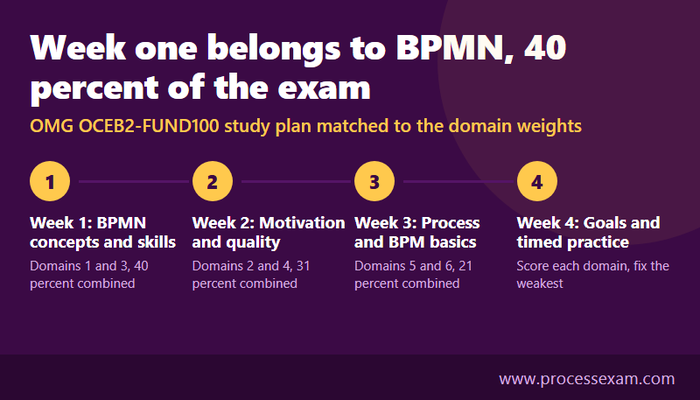
Week 1: BPMN Fundamentals (Domains 1 and 3, 40% combined)
Spend the first week almost entirely on BPMN 2.0.2. Learn every element in the descriptive and analytic conformance subclasses, then practice applying them to short scenarios rather than only memorizing shapes. Use the events chart to drill the different event types until you can identify each one without hesitation.
Week 2: Motivation Modeling and Quality Frameworks (Domains 2 and 4, 31% combined)
Move to the Business Motivation Model, building your own glossary of goals, objectives, means, ends, strategies and tactics with example sentences. Then work through the quality and governance frameworks in Domain 4 one at a time, writing a single sentence that captures what each framework is for.
Week 3: Process Fundamentals and Management Concepts (Domains 5 and 6, 21% combined)
Study the basics of what a process is and how organizations manage processes. Contrast As-Is and To-Be descriptions, and compare functional versus process-centric organizational styles until the distinctions feel automatic rather than memorized.
Week 4: Business Fundamentals, Timed Review and Final Pass
Give Business Goals and Objectives a light review, since it is the smallest domain. Spend the rest of the week on full-length timed practice sets, tracking your score by domain rather than only your overall total. Revisit whichever domain is weakest with one more focused review session before exam day.
Exam-Day Strategy and Common Pitfalls
Knowing the content well is only part of passing. The other part is managing 90 questions in a fixed time window without losing easy points to rushing or second-guessing.
Set checkpoints, not a single deadline
If you have 90 minutes for 90 questions, aim to be near question 30 at the 30-minute mark and near question 60 at the 60-minute mark. That leaves a buffer at the end for diagram-heavy questions you flagged to revisit.
Read the diagram before the question
For BPMN-based questions, look at the diagram first and identify every element you recognize before reading what is being asked. This prevents you from answering based on a partial read of the question text while missing a detail the diagram clearly shows.
Eliminate before you choose
Many OCEB2-FUND100 questions include one obviously wrong answer, one answer that is wrong for a subtle reason, and two that look close until you check a definition carefully. Eliminate the obviously wrong option first, then compare the remaining choices against the exact BPMN element, BMM term or framework name the question is testing. This two-step habit is faster under time pressure than trying to spot the single correct answer immediately.
Watch for these common traps
- Confusing a goal with an objective, or a strategy with a tactic, in Business Motivation Model questions
- Misreading an extended BPMN element as a basic one, or the reverse
- Answering based on an element's attributes, which the exam does not test
- Mixing up As-Is and To-Be process descriptions in a scenario
- Spending too long on one diagram question and running short on time for the easier conceptual questions later in the exam
Do not skip the smaller domains entirely
It is tempting to focus only on the 24% and 16% domains and treat the smaller ones as afterthoughts. Even an 8% domain is worth roughly seven questions, enough to matter when the passing line is 62 out of 90.
How Practice Tests Help With OCEB2-FUND100 Preparation
Practice tests are most useful for showing you which domain is actually weak, rather than which domain you feel unsure about. Those two things are not always the same, and a timed practice set with domain-by-domain scoring will usually surface the gap faster than self-assessment alone.
ProcessExam offers OCEB2-FUND100 practice questions organized around the same domains OMG publishes. The OCEB2-FUND100 syllabus on ProcessExam lists every domain so you can check your progress against it as you study. ProcessExam is an independent practice provider, not OMG, and practice questions cannot guarantee a pass. What they can do is help you get comfortable with the question style, including diagram-based items, before exam day.
If you are also considering a broader systems or architecture credential alongside BPM, this guide to certified system architect exam preparation covers a similar weight-based approach to practice testing that applies just as well here.
When you review a wrong answer, do not stop at the correct choice. Identify which of the seven domains it belongs to and note the specific distinction you missed, whether that is a BPMN element, a BMM term or a quality framework name. That habit turns scattered mistakes into a focused list of what to review next.
Frequently Asked Questions
What is the OMG OCEB2-FUND100 certification?
OCEB2-FUND100 is the OMG Certified Expert in BPM 2, Fundamental Level certification. It is the entry-level credential in OMG's BPM 2 program and tests BPMN 2.0.2 modeling concepts, business motivation modeling, process quality and governance frameworks, and general business process fundamentals. There are no formal prerequisites.
How many questions are on the OCEB2-FUND100 exam and how long is it?
The exam has 90 multiple choice questions, some built around diagrams and images. Candidates in English-speaking countries get 90 minutes, while candidates elsewhere get 120 minutes. A passing score is 62 out of 90 correct answers, or 69%.
Which OCEB2-FUND100 domain carries the most weight?
Business Process Modeling Concepts carries 24% of the exam, the largest single domain. Business Motivation Modeling and Business Process Modeling Skills each carry 16%, Process Quality, Governance, and Metrics Frameworks carries 15%, and the three remaining domains cover the final 29% combined.
How much does the OCEB2-FUND100 exam cost and how long is the certification valid?
The exam fee is 350 USD plus applicable taxes, and it is scheduled through Pearson VUE. The resulting certification is valid for three years from the exam date, after which it can be extended by retaking the same or a higher OCEB 2 level exam.
How can practice tests help with OCEB2-FUND100 preparation?
Timed, domain-tagged practice tests reveal which of the seven domains actually needs more study, which is not always the domain a candidate expects. They work best as a supplement to the official OMG study materials rather than a replacement, especially for diagram-based BPMN questions that benefit from repeated exposure.
Closing Thoughts
The OCEB2-FUND100 exam rewards candidates who study in proportion to the published weights rather than spreading effort evenly across seven domains. Business Process Modeling Concepts and Business Process Modeling Skills together make up 40% of the score, so BPMN fluency deserves the largest share of your preparation time, followed by business motivation modeling and the quality and governance frameworks. Build your plan around those weights, practice with timed and domain-tagged questions, and the smaller domains will feel like a quick review rather than new material on exam day.