PMI

The Professional Scrum Master II (PSM II) certification from Scrum.org validates an advanced understanding of Scrum principles and the ability to apply the framework effectively in complex organizational environments. Unlike the foundational PSM I, the PSM II focuses heavily on situational challenges, serving the Development Team, Product Owner, and the organization itself.
This credential is designed for practitioners who have significant experience working as a Scrum Master and are ready to tackle nuanced coaching, organizational impediments, and scaling challenges. Achieving the PSM II certification signifies a high level of professional maturity and deep knowledge of advanced scrum master concepts.
The PSM II distinguishes experienced Scrum Masters who can navigate difficult conversations, facilitate significant changes, and guide organizations through Agile transformation efforts. It moves beyond knowing the mechanics of Scrum and emphasizes the servant-leader capabilities required to truly evolve a team and system.
Candidates must demonstrate proficiency in empirical process control, stakeholder management, and deep team dynamics. The assessment tests not just theoretical knowledge but judgmental capacity under pressure.
The distinction between the PSM I and PSM II is critical for practitioners planning their career progression. While PSM I confirms basic proficiency, PSM II explores complexity and application.
Key areas where the PSM II level expertise differs:
The PSM II certification is a rigorous assessment designed by Scrum.org to test practical application and conceptual depth. Successfully navigating the exam requires dedication and focused study, often relying on exam prep tools and situational experience.
This assessment is distinct due to its open-book nature, which necessitates speed and familiarity with the Scrum Guide and related artifacts to achieve the required PSM II passing score.
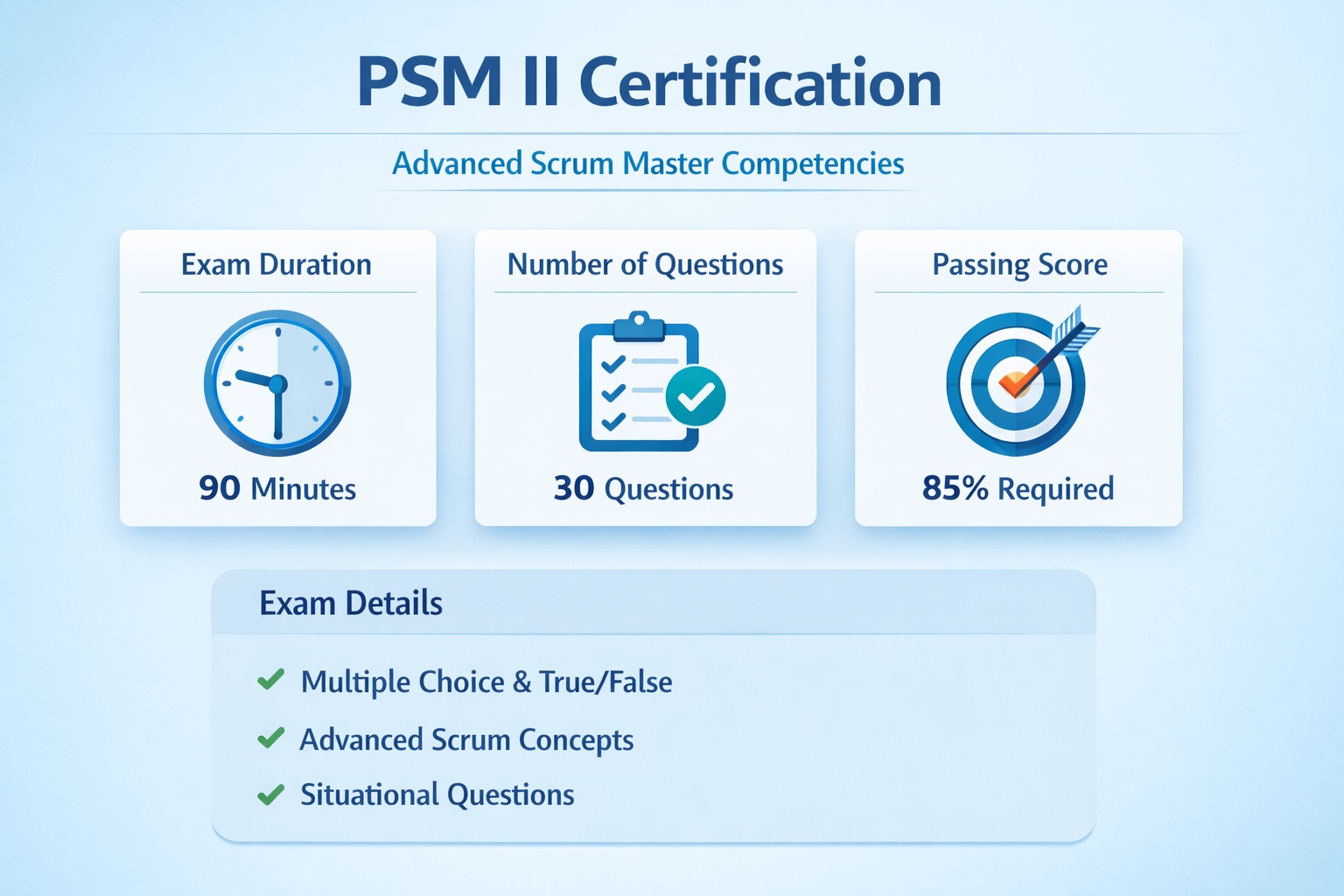
Detailed information about the PSM II exam structure:
Achieving the 85% passing score demands near-perfect accuracy, given the limited number of questions. Each question is typically complex, situational, and requires significant interpretive skill to determine the best course of action.
To pass the assessment, candidates must master the core professional scrum master II requirements outlined in the official exam syllabus. The PSM II exam topics move far beyond definitions and focus heavily on the application and rationale behind complex decisions.
The official Scrum org PSM II assessment covers five primary subject areas, ensuring a comprehensive evaluation of the advanced Scrum Master:
The depth required in these areas necessitates strong practical experience. Reviewing the sample Q&A set can provide context on the high level of situational detail expected in the questions.
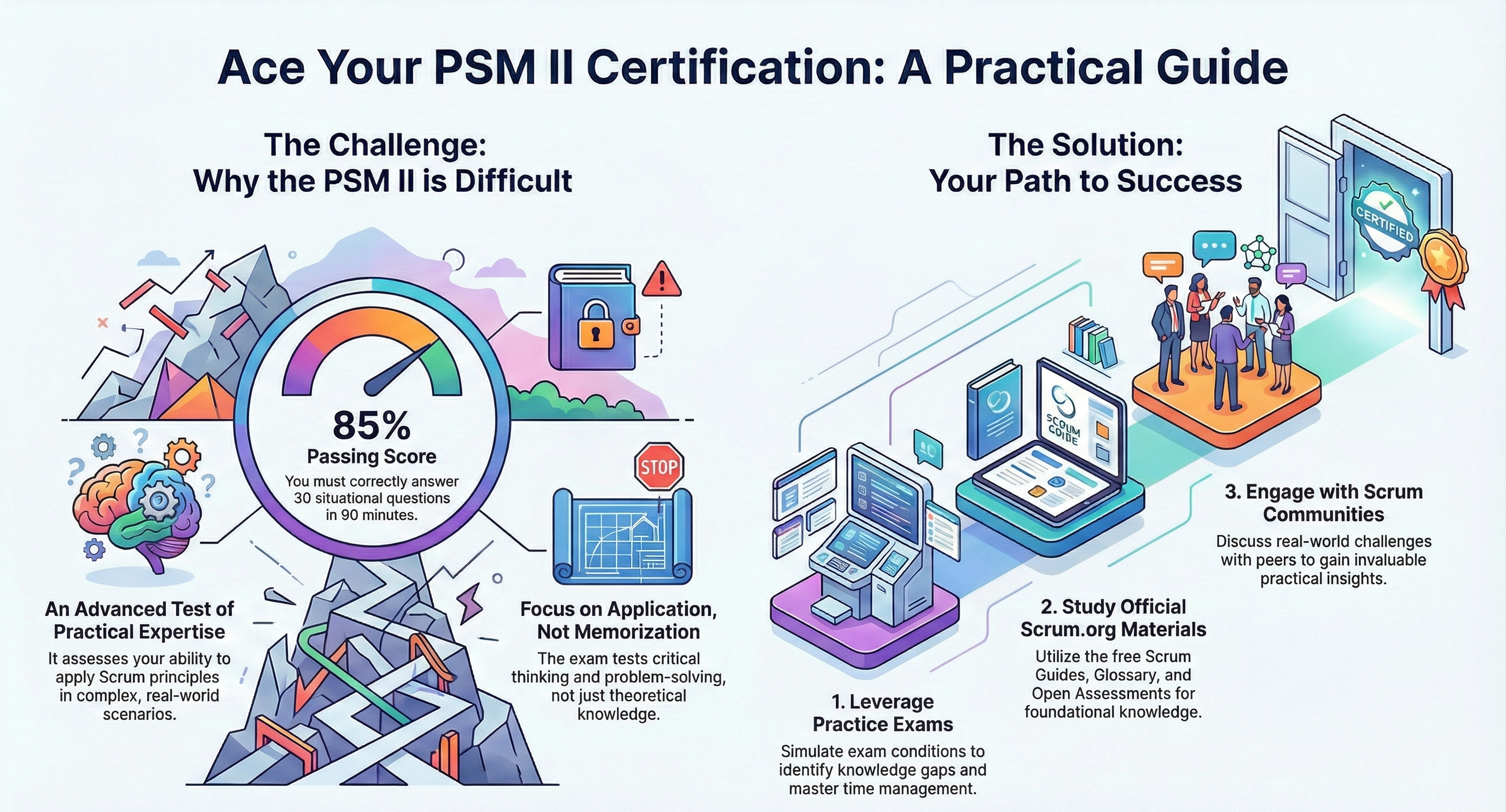
Effective PSM II exam preparation requires a shift in mindset from rote memorization to reflective practice. The PSM II exam difficulty is high, primarily because the questions test application and judgment rather than simple recall.
Successful candidates often employ structured study methods following a rigorous PSM II study guide approach:
It is important to understand that certification dumps provide false confidence and do not help candidates develop the critical thinking skills required by the Professional Scrum Master II requirements. Invest instead in quality, professionally validated resources.
High-quality practice resources are indispensable for developing the necessary speed and situational judgment. Since the time constraint (90 minutes for 30 complex questions) is severe, fluency is key in learning how to pass the PSM II exam.
Tips for using PSM II practice tests, free or paid resources, effectively:
Gaining confidence through iterative practice is a major factor in mastering advanced scrum master concepts. Reading experiences from others who have passed the assessment can also provide valuable insight into the preparation journey, as documented in various community posts and resources like professional articles.
 Career Impact and Return on Investment (ROI) of PSM II
For established professionals, the PSM II certification cost (USD $250) represents a significant investment in career advancement and specialization. Understanding whether PSM II is worth it depends heavily on career goals, but the ROI is typically high for those aspiring to senior or enterprise coaching roles.
The advanced knowledge validated by this certification opens doors to roles that demand complex organizational interaction:
This level of certification acts as proof of hands-on experience and advanced critical thinking, skills highly valued by organizations undertaking large-scale Agile transitions.
Unlike some certifications, Scrum.org Professional Scrum Master II requirements do not mandate annual PSM II renewal requirements or fees. Once earned, the certification remains valid indefinitely.
However, remaining relevant in the Agile space requires continuous learning to ensure competencies remain sharp:
Staying updated with the latest PSM II study guide materials and any updates to the official Scrum Guide is crucial for maintaining the advanced competency level validated by the official PSM II assessment.
The PSM II Certification is a critical milestone for any professional seeking mastery in the Scrum Master role. It rigorously tests the candidate’s ability to handle organizational complexity, coach difficult stakeholders, and serve as a true change agent within the enterprise. Achieving this credential validates experience and a deep, technical understanding of advanced Scrum concepts and application.
The high PSM II exam difficulty ensures that certified individuals are among the most capable Scrum Masters in the industry, equipped not just with knowledge, but with the necessary judgment to drive sustainable agility. Investing time in comprehensive preparation and using quality resources will maximize the chances of success on this demanding assessment.
If you are ready to validate your expert-level skills and begin serious preparation, start by accessing high-fidelity practice resources designed to replicate the challenging, situational format of the Scrum org PSM II assessment. Find structured study plans and practice assessment materials to guide your journey toward success at ProcessExam’s certification resources.
Question 1: What is the main difference between PSM I and PSM II certification?
Answer: The PSM I tests foundational knowledge of the Scrum Guide and basic application. The PSM II tests advanced, complex situational judgment, focusing on the Scrum Master’s role as a servant leader, coach, and change agent within the organization. It assesses how you handle real-world organizational impediments and team dynamics.
Question 2: Is the PSM II assessment open book, and how does that affect the difficulty?
Answer: Yes, the PSM II is open book, but the PSM II exam difficulty remains very high. This is because the challenge lies not in memorizing facts, but in correctly interpreting and applying the Scrum principles quickly under extreme time pressure. You must know exactly where to look for supporting guidance.
Question 3: How should I structure my PSM II study guide plan?
Answer: Focus your plan on gaining practical experience, deeply understanding the Scrum Guide accountability sections, and leveraging dedicated practice exams. Review specific topics like organizational change, coaching the Product Owner, and resolving deep conflict. Utilizing tools that provide high-quality PSM II sample questions is highly recommended.
Question 4: Are there any PSM II renewal requirements to keep the certification valid?
Answer: No, according to Scrum.org, the PSM II certification is lifetime and does not require periodic renewal fees or continuing education credits. However, staying current with the evolving Scrum Guide and agile practices is essential for professional relevance.
Question 5: Where can I find reliable PSM II practice tests, free or paid?
Answer: Reliable practice materials are crucial for success. While some organizations offer PSM II practice tests and free trials, dedicated platforms provide the best simulation. We suggest looking into practice assessments available from reputable providers like ProcessExam, ensuring they cover the advanced situational scenarios emphasized in the PSM II assessment.