



The ServiceNow Certified System Administrator (CSA) exam packs sixty questions into ninety minutes, and most candidates who fail it do not fail because they studied too little. They fail because they studied the wrong things in the wrong order. This guide lays out what the CSA credential actually covers, how the exam is structured, and a thirty day plan built for someone who is still working a full admin job while preparing.
By the end you will know what to expect walking into the Pearson VUE testing room, where first time candidates typically lose points, and how to use practice questions so they close gaps instead of just creating a false sense of readiness.
Who the ServiceNow CSA Credential Actually Serves
ServiceNow Certified System Administrator sits inside ServiceNow's Platform and AI certification category. It is the foundation credential for anyone who configures, maintains or supports a ServiceNow instance day to day rather than someone who only uses the platform as an end user filling out tickets.
That makes the exam a natural fit for junior ServiceNow administrators, IT support staff moving into platform ownership, and consultants who need a baseline credential before clients will let them near a production instance. It also suits developers and business analysts who work closely with ServiceNow but want formal proof of their administration skills.
You do not need a prior ServiceNow certification to sit the CSA exam, which is part of why it attracts such a wide range of candidates. What you do need is real comfort inside the Now Platform interface, because the exam assumes you have actually configured things, not just read about them.
Many candidates come to CSA from adjacent roles rather than a traditional IT career path. Help desk agents who want to move off the phones, business analysts who got pulled into platform work by accident, and project coordinators who ended up owning the service catalog all show up in CSA study groups for the same reason: the job grew faster than their formal training did, and the certification closes that gap on paper.
If you already hold access to a company instance through work, that is the single best preparation resource available to you, far better than any third party course on its own. Nothing replaces the muscle memory of actually clicking through forms, lists and configuration screens that your employer already pays for you to use.
The Exam at a Glance: Questions, Time, Fee and Pass Mark
Before building a study plan it helps to know exactly what you are preparing for. The CSA exam consists of 60 questions and gives candidates 90 minutes to answer them, which works out to a minute and a half per question on average.
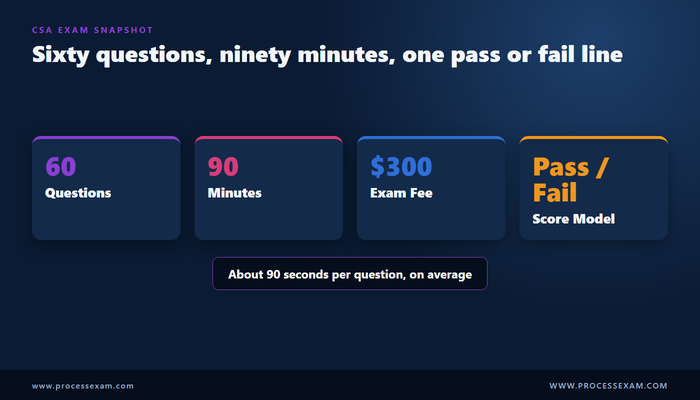
The exam fee is 300 USD, and the exam is scored as a straight pass or fail rather than a published numeric score shown on your results. ServiceNow does not publish one fixed passing percentage that applies to every version of the exam, since item difficulty is weighted behind the scenes. Candidates researching this often end up at a closer look at ServiceNow's own pass mark guidance, which walks through where that widely cited 70 percent figure actually comes from.
Full details on exam structure, retake policy and eligibility live on ServiceNow's CSA exam blueprint page, which is the only source worth trusting over forum posts or outdated blog summaries. Exam content and policy details change between ServiceNow releases, so treat that page as the final word if anything here conflicts with it.
Given the fee attached, it is worth asking up front whether the 300 dollar CSA exam is actually worth the cost for your specific career stage, before you commit to a testing date and start building a study schedule around it.
If a first attempt does not go your way, resist the temptation to rebook immediately out of frustration. A short gap to review exactly which areas felt weak, using whatever score breakdown ServiceNow provides after the attempt, almost always produces a better second outcome than rushing straight back in with the same gaps unaddressed.
What a ServiceNow System Administrator Needs to Know Cold
The CSA exam is built around the daily responsibilities of a working ServiceNow administrator, not abstract theory. That means the exam rewards candidates who have spent real hours inside a developer instance clicking through menus, not just reading slide decks.
Expect the exam to lean heavily on core administration skills: navigating the Now Platform user interface efficiently, managing users, groups and roles, configuring the Service Catalog and record producers, setting up notifications and basic workflow activities, and working with update sets to move configuration between instances safely.
Reporting and basic performance analytics also show up, since administrators are routinely asked to build dashboards and pull data for stakeholders. So does a working understanding of access controls, meaning how roles and access control rules decide who can see or change what inside an instance.
None of this is exotic knowledge. It is exactly what a competent admin does during a normal week, which is why hands on practice in a personal developer instance consistently outperforms passive reading when it comes to retaining this material. ProcessExam's CSA syllabus breakdown lays out these administration areas in more detail if you want a fuller checklist to study against.
A smaller but still testable slice of the exam touches the Configuration Management Database, or CMDB, at a conceptual level. You are not expected to design a CMDB from scratch, but you should know what a configuration item is, how relationships between items are represented, and why keeping that data accurate matters for everything from incident management to change approvals built on top of it.
Client scripts, UI policies and basic form configuration also appear, though CSA stays at the level of understanding what these tools do and when an administrator would reach for one, rather than writing complex script logic. That deeper scripting work belongs to the developer track, which is worth knowing so you do not over study topics that sit outside this particular exam's scope.
Knowledge Management is another area that rewards a few hours of hands on time. Creating a knowledge base, publishing an article through its approval workflow, and understanding how articles surface to end users through the Service Portal all come up in some form, and each one is faster to learn by doing than by reading a description of the process.
Why This Badge Moves a ServiceNow Career Forward
ServiceNow certifications carry weight in the job market because ServiceNow itself gates a lot of partner and consulting work behind certified headcount. Companies that resell or implement ServiceNow need a certain number of certified administrators and developers on staff to keep their partner status, which creates steady demand for CSA holders regardless of the wider hiring climate.
For someone already working help desk or junior sysadmin roles, the CSA credential is usually the fastest route into a dedicated ServiceNow administrator title, often with a meaningful pay increase attached. It also signals to a hiring manager that you can be trusted with production configuration changes without months of ramp up time.
CSA is also the usual stepping stone toward specialist tracks. Many administrators use it as the prerequisite experience before attempting the ServiceNow Certified Application Developer credential, which opens doors into scripting and custom application work on the platform rather than pure configuration.
Even candidates who do not plan to specialize further benefit from the credibility boost. Recruiters searching for ServiceNow talent filter heavily on certification names, and CSA is one of the first filters they apply.
There is also an internal mobility angle that gets less attention than external job hunting. Employees who already work inside a company running ServiceNow often use the CSA credential to formally move from a support or coordinator role into the platform team itself, without needing to change employers at all. Having the certification already in hand removes one of the biggest objections a hiring manager might otherwise raise.
Because ServiceNow releases new platform versions on a regular cycle, staying certified also tends to keep administrators closer to current features than peers who learned the platform once and stopped actively studying it. That ongoing familiarity compounds over a career in a way that is hard to quantify but easy to notice once you are a few years into working with the platform.
Building a 30-Day Study Runway Around a Day Job
Thirty days is enough time to prepare properly for the CSA exam if you are already working with ServiceNow in some capacity, and tight but workable if you are starting closer to zero. The plan below assumes roughly an hour on weekdays and two to three hours on one weekend day, which fits around most full time jobs.
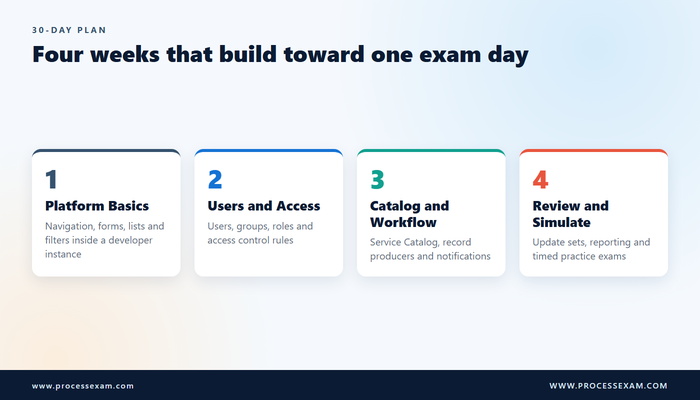
The structure deliberately front loads the areas that take longest to build real comfort with, namely platform navigation and user and role administration, and saves the lighter conceptual topics for later weeks when exam fatigue starts to set in.
Treat the plan as a skeleton rather than a rigid schedule. If week one reveals that user administration needs another few days, take them. The goal is genuine competence walking into the testing room, not finishing a checklist on time.
Week by Week: What the Plan Actually Looks Like
Week one centers on the Now Platform interface itself: list views, forms, filters, favorites and the general navigation patterns that every other topic sits on top of. Spend real time inside a personal developer instance rather than only watching walkthrough videos, since the exam expects muscle memory, not recognition.
Week two moves into users, groups, roles and access control rules. This is one of the densest areas on the exam, because small differences in how a role is scoped can change what a user can see or do across the entire instance. Build a few test users and groups yourself and experiment with breaking and fixing their access rather than memorizing definitions.
Week three covers the Service Catalog, record producers, notifications and basic workflow activities, which together make up a large share of what administrators actually do day to day. Build a simple catalog item from scratch, attach a record producer to it, and trigger a notification off a state change so the concepts connect to something you built with your own hands.
Week four is review and exam simulation. Revisit update sets and reporting basics, then spend the majority of the week on timed practice questions that mirror the real exam's pacing. This is also the week to book your Pearson VUE slot if you have not already, so you have a fixed date forcing focus during the final push.
Keep a running list of anything that still feels shaky as you move through each week, rather than trusting yourself to remember it later. That list becomes the backbone of your final review days, and it is almost always shorter and more specific than a generic reread of every topic would be.
Inside the Pearson VUE Testing Room
The CSA exam is delivered through Pearson VUE, either at a physical test center or online with a system and environment check beforehand. Either way, confirm your testing method and run any required system check well before exam day, since last minute technical issues are a common and entirely avoidable source of stress.
Arrive, or log in for an online exam, with identification ready and nothing in reach that the proctor has not explicitly allowed. Online proctoring is typically strict about a clear desk and an unobstructed view of your hands and screen, so set up your space in advance rather than scrambling at the last minute.
Once the exam starts, resist the urge to dwell on any single question. With 60 questions in 90 minutes you have room to flag a handful of uncertain answers and return to them, but only if you keep moving through the rest at a steady pace. A candidate who spends ten minutes on one tricky access control question can end up rushing through five easier questions later as a direct result.
Where CSA Candidates Lose Points Most Often
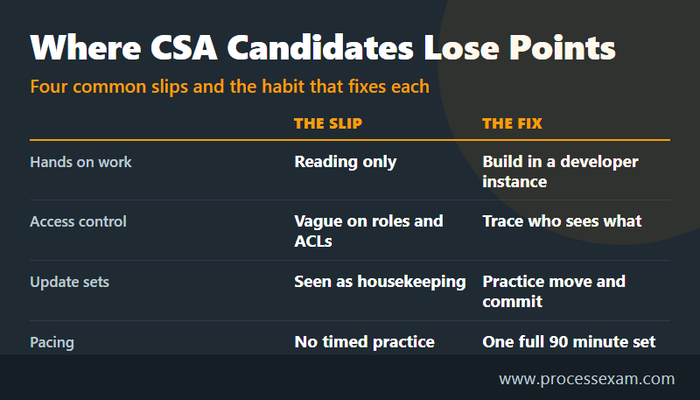
The single most common mistake is studying ServiceNow concepts in the abstract without ever opening a developer instance. Reading about record producers is not the same as building one, and the exam is written by people who expect hands on familiarity, not textbook recall.
A close second is underestimating the access control questions. Roles, groups and access control rules interact in ways that are easy to describe loosely but hard to reason about precisely under time pressure, and the exam often tests exactly that precision with scenario based questions rather than simple definitions.
Candidates also tend to rush the update set questions, treating them as a minor housekeeping topic rather than a core administration skill. Mishandling update sets is a realistic way to break a production instance in the real world, which is exactly why ServiceNow treats it as exam worthy material rather than an afterthought.
Finally, many first time candidates walk in without ever having taken a single timed practice exam. Knowing the material and performing under a ticking ninety minute clock are different skills, and the gap between them is where otherwise well prepared candidates lose their margin.
A less obvious mistake is studying only the areas that feel comfortable and quietly avoiding the ones that do not. It is natural to spend more time on topics you already enjoy, but the exam does not weight questions by how much you enjoyed preparing for them, so an honest self assessment partway through the plan matters more than it might seem.
How Practice Tests Catch What Reading Missed
Practice questions are most useful when you treat the results as a map of weak spots rather than a score to feel good or bad about. A wrong answer on a Service Catalog question tells you exactly where to go back and rebuild something hands on, which is far more valuable than a vague sense that you should study catalog topics more.
ProcessExam offers CSA practice questions built around the same administration areas the real exam covers, which works well as a diagnostic tool during week four of the study plan above. Running a timed set under exam like conditions also trains the pacing instinct that reading alone cannot teach, since you learn how fast a minute and a half per question actually feels once the clock is running.
Treat any practice resource, ProcessExam's or otherwise, as a supplement to hands on platform work rather than a replacement for it. The candidates who struggle most tend to be the ones who memorized answer patterns from repeated practice sets without ever touching the underlying ServiceNow concepts in a real instance.
Run at least one full length practice set in a single sitting, with no pauses and no notes nearby, before exam day. A fragmented approach of ten questions here and ten questions there builds familiarity with content but does nothing for the stamina and pacing control that the real ninety minute block demands, and that gap only becomes obvious once the actual clock starts running.
How CSA Fits Into ServiceNow's Wider Certification Path
CSA is intentionally designed as a foundation rather than a destination. ServiceNow builds its certification track so that administrators who want to specialize can layer additional credentials on top of CSA once they have it, rather than starting over from scratch in a different track.
Administrators who gravitate toward building custom applications typically move toward the developer track next, while those who prefer deep expertise in a single process area, such as IT service management or security operations, tend to pursue the relevant Certified Implementation Specialist credential for that domain. Both paths assume the platform fluency that CSA already certifies, which is exactly why skipping ahead to a specialist exam without CSA first tends to leave gaps that show up later.
Thinking about this path early, even if you only plan to sit CSA for now, can shape which optional topics are worth extra attention during your thirty days of preparation. A candidate who already knows they want to move into application development, for instance, benefits from paying closer attention to the scripting adjacent topics on CSA, even though those topics stay conceptual at this level.
Frequently Asked Questions
What is the ServiceNow CSA certification?
ServiceNow Certified System Administrator, or CSA, is ServiceNow's foundation credential for professionals who configure and maintain a ServiceNow instance. It sits in ServiceNow's Platform and AI certification category and covers core administration tasks like user management, the Service Catalog, notifications, update sets and basic reporting.
How many questions are on the CSA exam and how long do candidates get?
The CSA exam has 60 questions, and candidates get 90 minutes to complete it. That works out to roughly a minute and a half per question, which is enough time if you keep a steady pace and avoid getting stuck on any single scenario question.
How much does the ServiceNow CSA exam cost and where is it scheduled?
The CSA exam fee is 300 USD. It is delivered through Pearson VUE, either at a physical test center or online with a system check beforehand, so candidates can choose whichever format fits their situation.
Is the ServiceNow CSA exam pass or fail, or is there a published passing score?
ServiceNow scores the CSA exam as a straight pass or fail rather than releasing a specific numeric score to candidates afterward. ServiceNow does not publish one fixed passing percentage for every version of the exam, since difficulty weighting varies behind the scenes between question sets.
How can practice tests help with CSA exam preparation?
Timed practice questions reveal exactly which administration areas still need work, which is more useful than a general feeling of being unprepared in some vague sense. They also train the pacing needed to comfortably finish 60 questions inside the 90 minute window on exam day.
Before You Book the Exam
The CSA exam rewards candidates who have genuinely used ServiceNow, not just read about it. Spend real time inside a developer instance, work through the thirty day plan at a pace that fits your schedule, and use timed practice questions in the final week to convert knowledge into exam day performance.
Book your Pearson VUE slot once your practice scores feel consistent rather than lucky, and walk in treating the ninety minutes as a pacing exercise as much as a knowledge test.